

WE HAVE REOPENED! Our team has worked hard to repair, inspect, and prepare our course following Hurricane Lala.
We're ready to safely welcome you back !
BOOKINGS ARE OPEN!
Mahalo for your patience and support! 💛
Located right in Waikapu, Maui Tropical Plantation is a must-visit destination for those looking to experience the island’s lush landscapes, rich agricultural history, and vibrant cultural heritage. Spanning 500 acres, this beautiful plantation offers visitors an immersive look into Hawaii’s tropical agriculture while providing a serene escape into nature.
Maui Tropical Plantation is more than just a scenic retreat—it is a living, breathing testament to Hawaii’s farming traditions. Guests can embark on the popular Tropical Express Tour, a guided tram ride through the plantation’s sprawling fields. Along the way, visitors will witness a variety of tropical crops, including coffee, papaya, coconut, mango, and taro, while learning about their significance in Hawaiian culture and history.
Since its establishment in 1983, Maui Tropical Plantation has been a premier destination for visitors seeking to learn about the island’s rich agricultural traditions. Originally designed to showcase how Maui’s crops are grown, the plantation continues to offer an immersive and educational experience today.
One of the highlights of a visit is the 45-minute tram tour, where local guides lead guests through the plantation’s sprawling 1,500 acres, featuring an impressive variety of 65 crops. Among the lush fields, visitors can see and learn about pineapple, banana, papaya, starfruit, coffee, guava, coconut, macadamia nuts, taro, avocado, and even newly introduced sunflowers—a recent addition to Maui’s agricultural landscape. Seasonal variations ensure that each tour offers something unique.
The tram tour operates hourly from 10 AM to 4 PM, providing ample opportunities to explore the plantation’s beauty. Tickets can be purchased conveniently at the Plantation Store entrance or online.
https://mauitropicalplantation.com/tour-tickets
Maui Tropical Plantation provides a variety of interactive experiences that appeal to visitors of all ages. Whether you’re seeking adventure or a deeper appreciation of Hawaiian farming traditions, the plantation offers something for everyone. For thrill-seekers, the plantation’s zipline course provides an exhilarating way to take in the stunning surroundings. As you soar above the lush fields, you’ll be treated to a breathtaking bird’s-eye view of the towering palm trees, tropical crops, and vibrant floral gardens. The zipline is designed to be both exciting and family-friendly, making it a must-try experience for those looking to add a bit of adrenaline to their visit.
For visitors interested in a more grounded, hands-on approach, the plantation offers engaging demonstrations that highlight traditional Hawaiian agricultural practices. One of the most popular activities is the coconut husking demonstration, where guests can witness firsthand the skill and technique required to open a coconut using time-honored methods. These demonstrations provide an educational glimpse into Hawaiian farming heritage, connecting guests to the island’s deep-rooted agricultural traditions.
A visit to Maui Tropical Plantation wouldn’t be complete without savoring the flavors of the island at The Mill House restaurant. Known for its farm-to-table dining, The Mill House sources fresh ingredients directly from the plantation and local farmers. Guests can indulge in exquisite dishes that highlight the island’s seasonal bounty while enjoying breathtaking views of the West Maui Mountains or Mauna Kahālāwai.
Maui Tropical Plantation is committed to sustainability and preserving the island’s agricultural heritage. Through eco-friendly practices and community engagement, the plantation plays a vital role in educating visitors about the importance of sustainable farming and environmental stewardship.
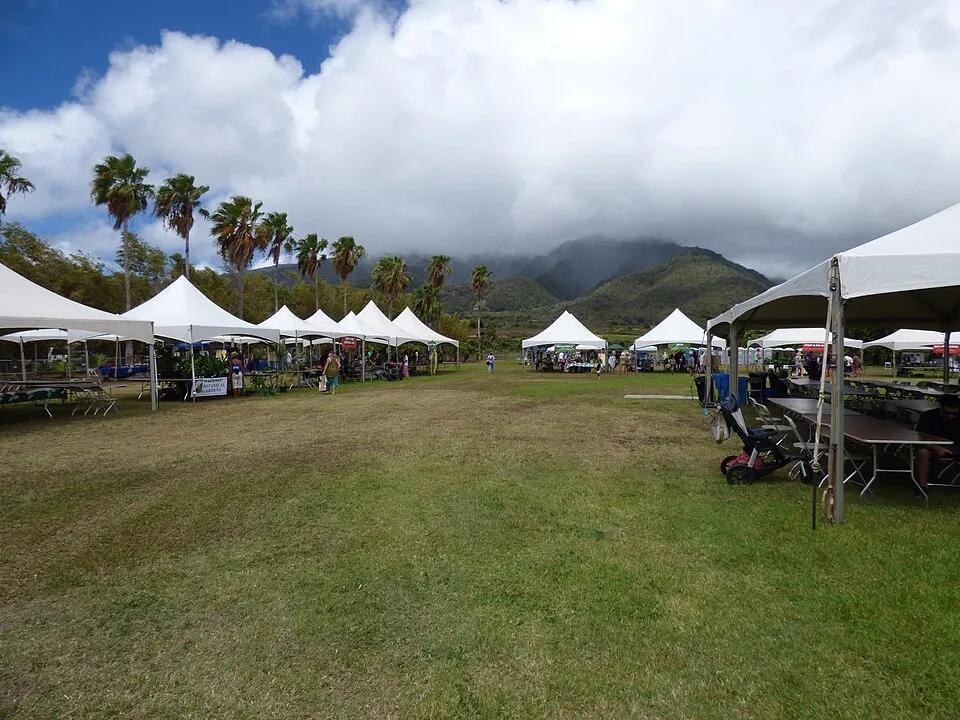
Whether you’re a first-time visitor to Maui or a returning traveler, Maui Tropical Plantation offers a unique blend of adventure, history, and relaxation. With its stunning landscapes, engaging experiences, and dedication to preserving Hawaii’s agricultural traditions, it remains a cherished destination for all who seek to explore the beauty of the island.
Discover the heart of Maui—visit Maui Tropical Plantation and experience the island’s agricultural paradise firsthand.
https://mauitropicalplantation.com/
Yes. Maui Tropical Plantation is a worthwhile stop for visitors interested in Maui's tropical plants, agriculture, local products, scenery, and history. The property offers a different experience from Maui's beaches and ocean activities and can easily be incorporated into a day exploring Central Maui.
Maui Tropical Plantation is located at 1670 Honoapiʻilani Highway in Waikapū, Maui. Its Central Maui location makes it convenient to reach from Kahului, Wailuku, Kīhei, and other popular areas of the island.
Visitors can explore portions of Maui Tropical Plantation without purchasing a Tropical Express ticket. However, activities such as the Tropical Express and zipline are paid experiences. Shopping and dining costs are also separate. Check current pricing before visiting, as rates and available activities can change.
Visitors can explore the tropical surroundings, learn about Hawaiian agriculture, shop for locally inspired products, enjoy food and drinks, and take the Tropical Express through parts of the property. Other activities, including a family-friendly zipline course, are also available.
The Tropical Express is a guided tram experience that takes visitors through areas of Maui Tropical Plantation while introducing them to tropical fruits, plants, and Maui's agricultural landscape. The approximately 40-minute experience also includes a coconut husking demonstration.
Plan on spending approximately one to three hours at Maui Tropical Plantation, depending on what you want to experience. Visitors taking the Tropical Express can combine the tour with time exploring the grounds, shopping, taking photos, or enjoying a meal. Those participating in additional activities may want to set aside more time.
Yes. Maui Tropical Plantation can be a great family-friendly Maui attraction. Children can see tropical plants and fruits growing around the property, while the Tropical Express provides an educational experience without requiring a strenuous hike. Families looking for more adventure can also explore the plantation's available outdoor activities.
Maui Tropical Plantation showcases many plants associated with Hawaiʻi's tropical environment and agricultural history. Depending on the season and areas visited, guests may see crops and plants such as coconut, banana, papaya, coffee, mango, taro, macadamia nuts, avocado, and colorful tropical flowers.
You do not necessarily need a reservation simply to visit the property, but purchasing tickets in advance for specific tours and activities is a good idea. Availability and operating schedules can vary, so visitors should check the official Maui Tropical Plantation website when planning their day.
Hours vary depending on the attraction, restaurant, or shop you plan to visit. The Tropical Express currently operates Tuesday through Sunday from 9 AM to 3 PM. Because schedules can change, check current operating hours directly with Maui Tropical Plantation before your visit.
Yes. Visitors can enjoy food and drinks without leaving the plantation. Cafe O'Lei at the Plantation serves island-inspired food with views of the surrounding Waikapū landscape, while the Country Market includes the Kumu Cafe and Farm Bar along with locally grown produce and other products.
Yes. You do not have to take the Tropical Express to enjoy the plantation's dining and shopping options. This makes Maui Tropical Plantation a convenient stop even for travelers who only want to enjoy a meal, browse local products, or spend some time exploring the property.
Yes. Maui Tropical Plantation has several shopping opportunities featuring locally grown produce, coffee, handmade goods, gifts, and products from Maui businesses and artisans. It can be a good place to look for locally inspired items while supporting Maui farmers, makers, and small businesses.
Yes. A separate zipline experience operates at Maui Tropical Plantation. The course features five side-by-side ziplines over farmland, gardens, and the plantation's lagoon and is designed as a family-friendly adventure.
Maui Tropical Plantation can still be worth considering when Maui experiences passing showers, although some activities take place outdoors. Weather can affect tours and other attractions, so check current conditions and activity availability before heading to the plantation during periods of heavier rain.
Comfortable, casual clothing and walking shoes are generally appropriate. Maui's weather can be warm and sunny, so consider bringing sunscreen, a hat, sunglasses, and water. A light rain jacket can also be useful when showers are in the forecast.
Yes. Maui Tropical Plantation is located in Waikapū in Central Maui, making it relatively convenient to Kahului and Kahului Airport compared with attractions farther away in West Maui, Upcountry, or along the Road to Hāna. This can make the plantation a useful addition to an arrival or departure day when your schedule allows.
Its Central Maui location makes Maui Tropical Plantation easy to combine with other activities around Wailuku, Waikapū, and Kahului. Visitors can explore ʻĪao Valley, discover local shops and restaurants, visit cultural and historic attractions, or continue toward other parts of Maui for beaches, hiking, sightseeing, and outdoor adventures.
No. Although Maui Tropical Plantation is a popular visitor attraction, its restaurants, markets, local products, events, and scenic setting can also appeal to Maui residents. The plantation provides a place to learn more about agriculture while supporting businesses and producers connected to the island.
If you would like to read and learn more about interesting things in Hawaii! Check out our blog page here on our website!
or
Image Credits:
Hero:
Royal Poinciana (Delonix regia) at Maui Tropical Plantation — Photo by Forest and Kim Starr, via Wikimedia Commons, licensed under Creative Commons Attribution 3.0 United States (CC BY 3.0 US).
Indigenous Crop Biodiversity Festival, Maui Tropical Plantation — Photo by Forest and Kim Starr, via Wikimedia Commons, licensed under Creative Commons Attribution 3.0 US (CC BY 3.0 US).
In the lush embrace of the West Maui Mountains or better known as Mauna Kahalawai, ʻĪao Valley is one of Hawaii’s most breathtaking and historically significant locations. With its emerald-green peaks, misty waterfalls, and deep cultural roots, this valley is more than just a scenic destination—it’s a place where history and nature intertwine. However, beneath its serene beauty lies a dramatic and bloody past, etched in Hawaiian history as the site of one of the most pivotal battles ever fought in the islands.
ʻĪao Valley is a deeply spiritual and sacred place for Native Hawaiians. The valley is home to the iconic ʻĪao Needle, a 1,200-foot-tall basalt pinnacle covered in lush vegetation. The name "ʻĪao" in Hawaiian means "supreme cloud", as the ʻĪao needle is often covered in a layer of clouds. The Needle is the tip of a long, winding ridge shaped by streams and waterfalls that gradually eroded the softer rock around it. Īao Valley, enclosed by the towering walls of Puʻu Kukui Crater, is a remnant of the central crater of Mauna Kahalawai, the ancient West Maui volcano. This natural monument, once used as a lookout by Hawaiian warriors, stands as a silent guardian over the valley.
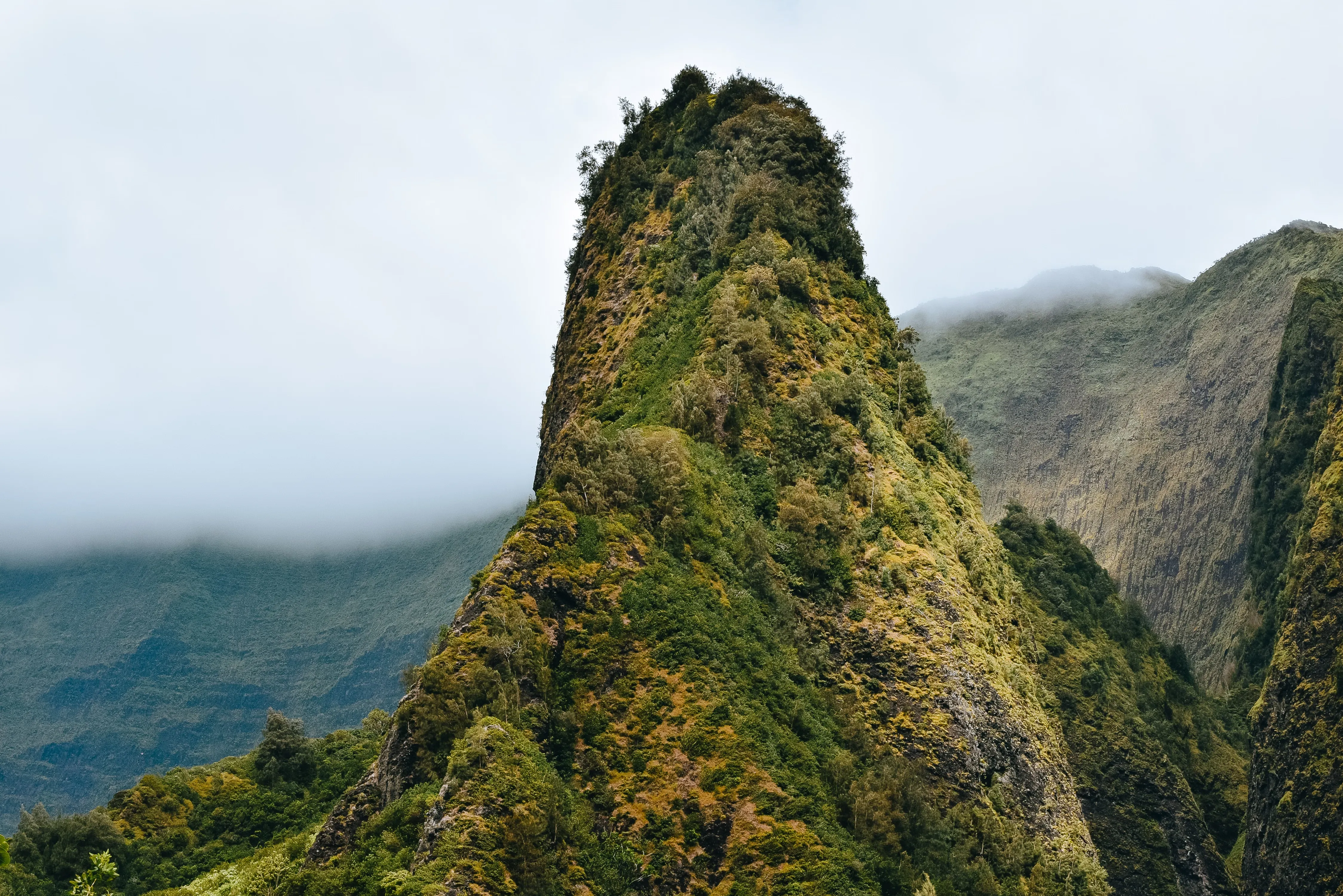
The area receives frequent rainfall, making it one of the wettest places in Hawaii. Its streams and waterfalls nourish the surrounding flora, creating a verdant paradise that has long been revered by locals and visitors alike.
The ʻĪao Stream, which winds through the valley, can quickly transform into a powerful torrent during storms, leading to flash floods, landslides, and significant erosion. In 2016, a major flood event destroyed sections of the state park, washing away roads, trails, and parts of the parking lot. Restoration efforts have since reinforced riverbanks and infrastructure, but the valley remains highly vulnerable.
*Visitors are urged to check weather conditions before exploring and respect any closures. While ʻĪao’s beauty is undeniable, its ever-changing landscape is a powerful reminder of nature’s force in shaping Maui’s terrain.*
Today, the ʻĪao Valley State Monument offers well-maintained trails and viewpoints, allowing travelers to appreciate the valley’s majesty while reflecting on its storied past. Upon visiting and walking in ʻĪao valley, there are signs posted throughout the area teaching you Hawaiian prayers, and Hawaiian sayings enhancing the atmosphere of the area.
Despite its beautiful and lush appearance today, ʻĪao Valley was the site of one of the bloodiest conflicts in Hawaiian history—the Battle of Kepaniwai, fought in 1790. This battle was a turning point in King Kamehameha I’s relentless campaign to unite the Hawaiian Islands. At the time, Maui was ruled by King Kahekili, a formidable leader who had successfully resisted Kamehameha’s advances. However, in 1790, while Kahekili was away on Oʻahu, Kamehameha saw an opportunity to strike.Kamehameha’s forces, armed with Western firearms acquired from European traders, landed on Maui and advanced toward ʻĪao Valley, where they faced Maui’s warriors led by Kahekili’s son, Kalanikūpule. The battle was fierce and unforgiving, with Kamehameha’s superior firepower ultimately overwhelming Maui’s defenders.
*NOT AN ACTUAL REFERENCE OF THE BATTLE*
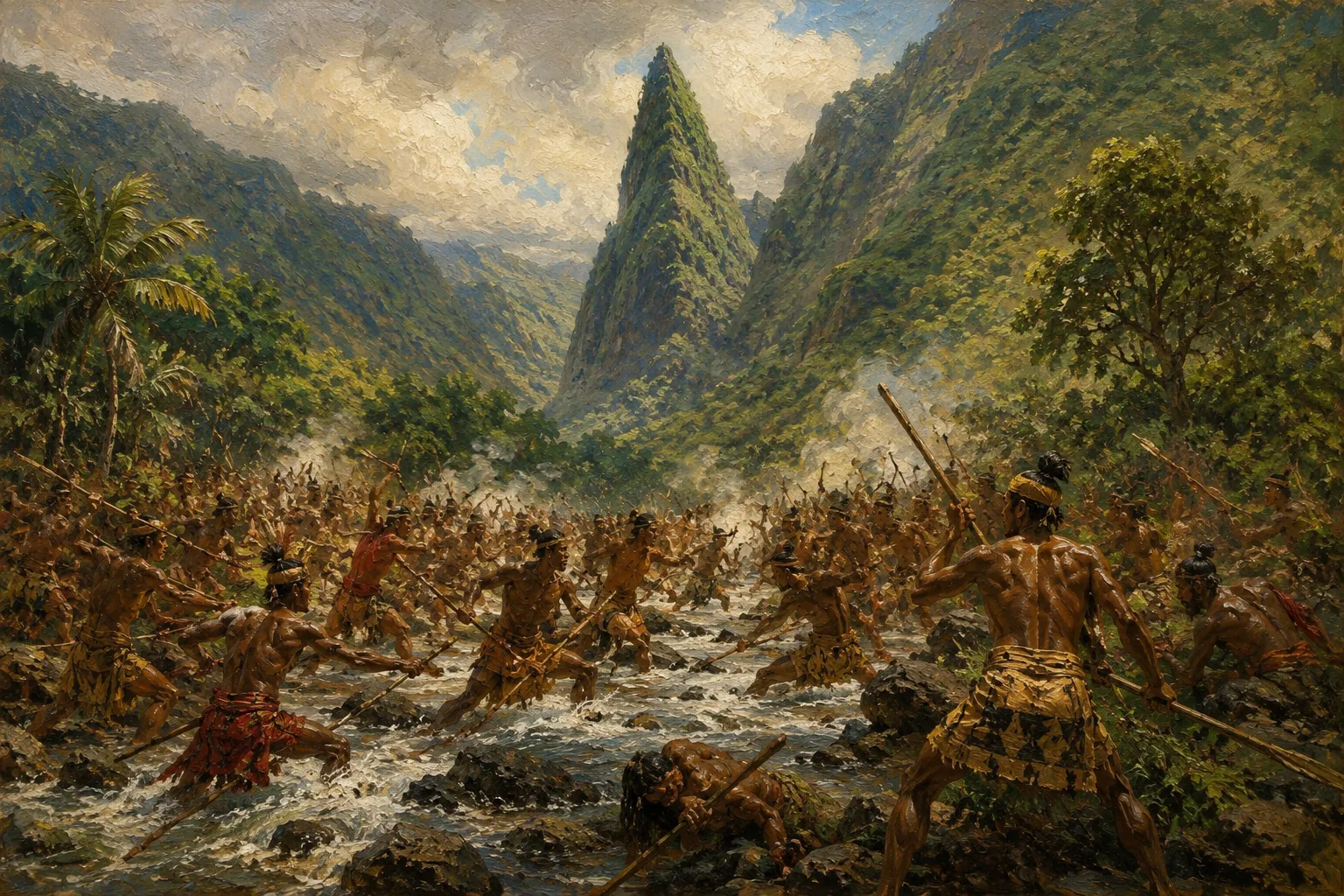
The slaughter was so intense that it is said the waters of ʻĪao Stream were choked with the bodies of fallen warriors, giving rise to the battle’s haunting name—Kepaniwai, meaning “the damming of the waters.” The river quite literally ran red with blood, marking one of the most devastating defeats in Maui’s history.
Although Kamehameha emerged victorious, he was unable to fully secure Maui at that time, as Kahekili later returned and reclaimed control. However, this battle foreshadowed Kamehameha’s eventual conquest of all the Hawaiian Islands, culminating in the unification of the kingdom in 1810.
Today, ʻĪao Valley stands as a place of reflection and reverence. Visitors who walk its trails are not only stepping into a natural wonderland but also onto a battlefield where warriors fought for their land and legacy. Hawaiian cultural practitioners continue to honor the spirits of those who perished here, ensuring that the valley’s history is never forgotten.
If you plan to visit ʻĪao Valley, take the time to appreciate both its breathtaking scenery and its profound historical significance. The ʻĪao Valley State Monument is easily accessible from Wailuku and offers a short but rewarding hike to vantage points where you can admire the towering peaks and lush landscapes.
While exploring, remember that this land is sacred. Respect the valley by staying on designated paths, avoiding the disturbance of cultural sites, and embracing the deep spiritual energy that continues to flow through its misty air.
ʻĪao Valley is a testament to both the resilience of nature and the enduring power of Hawaiian history. Whether you visit to learn, to reflect, or simply to take in its awe-inspiring beauty, this sacred valley will leave an indelible mark on your soul.
If you would like to set a reservation for Iao Valley, this is the only website you are able to set a date and time for your adventure: https://gostateparks.hawaii.gov/iao-valley
ʻĪao Valley is famous for its dramatic rainforest scenery, the iconic Kukaʻemoku or ʻĪao Needle, and its importance in Hawaiian history. The valley was also the site of the Battle of Kepaniwai in 1790, a major battle during Kamehameha I's campaign to unite the Hawaiian Islands.
The Battle of Kepaniwai took place in ʻĪao Valley in 1790 between the forces of Kamehameha I and the Maui army led by Kahekili II's son, Kalanikūpule. Kamehameha's forces ultimately prevailed in the fierce battle, strengthening his campaign to bring the Hawaiian Islands under unified rule.
The name Kepaniwai is commonly translated as "the damming of the waters." Accounts of the battle describe fighting so intense that the bodies of fallen warriors obstructed ʻĪao Stream, giving rise to the name and making the battle one of the most remembered conflicts in Hawaiian history.
"River of Blood" is a dramatic description associated with stories of the Battle of Kepaniwai rather than the official name of ʻĪao Stream or ʻĪao Valley. Historical accounts describe an exceptionally violent battle in which large numbers of warriors were killed along the stream.
The battle was fought between the invading forces of Kamehameha I and Maui forces commanded by Kalanikūpule, the son of Maui's ruler Kahekili II. Kamehameha's army included warriors from Hawaiʻi Island as he continued his campaign to expand his rule.
Kamehameha's forces defeated the Maui army at the Battle of Kepaniwai in 1790, giving him an important military victory. However, the political unification of the Hawaiian Islands was a longer process, and the Battle of Kepaniwai was one major event within that larger history.
ʻĪao Valley holds deep cultural and spiritual significance in Hawaiian history. In addition to being the location of the Battle of Kepaniwai, the valley was associated with Hawaiian chiefs and was valued for its abundant water, fertile environment, and protected location within the West Maui Mountains.
The famous ʻĪao Needle is traditionally known as Kukaʻemoku. It is an erosional feature covered in vegetation that rises approximately 1,200 feet from the valley floor. Visitors can view it from the paved ʻĪao Needle Lookout Trail.
No. Visitors do not hike to the top of Kukaʻemoku. Instead, the official ʻĪao Needle Lookout Trail provides a scenic viewpoint of the formation and surrounding valley.
The official ʻĪao Needle Lookout Trail and Ethnobotanical Loop is approximately 0.6 miles. It is a paved walk with about 200 feet of elevation gain and provides views of Kukaʻemoku along with opportunities to learn about plants associated with Hawaiian culture.
The official trail is considered an easy walk rather than a strenuous backcountry hike. The paved route is relatively short, although it does include stairs and elevation changes. Wet weather can also make surfaces slippery.
Out-of-state visitors currently need advance reservations to enter ʻĪao Valley State Monument. Reservations include specific entry periods and should be made before arriving. Hawaiʻi residents with a valid Hawaiʻi driver's license or state ID do not need to pay the standard entry or parking fees.
Current nonresident fees are $5 per person for entry and $10 per vehicle for parking. Children age three and under are admitted free. Hawaiʻi residents with valid state identification receive free entry and parking. Always check the official Hawaiʻi State Parks website for current pricing before visiting.
ʻĪao Valley State Monument is currently open daily from 7:00 a.m. to 6:00 p.m. Hours and access can change because of maintenance, weather, flooding, or other conditions, so visitors should check current park notices before traveling to the valley.
Many visitors can comfortably explore the main lookout and botanical areas in approximately one to two hours. Travelers interested in photography, Hawaiian history, plants, and spending more time enjoying the scenery may want to stay longer.
Yes. ʻĪao Valley offers a combination of natural beauty, Hawaiian history, cultural significance, and an accessible walking trail. It is especially appealing to travelers who want to experience something beyond Maui's beaches.
Yes. The relatively short paved trail makes ʻĪao Valley one of Maui's more approachable natural attractions for families. Parents should still supervise children around stairs, streams, wet surfaces, and steep terrain.
ʻĪao Valley is located within the lush West Maui Mountains and receives considerable rainfall. Passing showers, clouds, and wet conditions are common and contribute to the valley's dense tropical vegetation. Visitors should be prepared for changing weather.
Visitors should follow all current State Parks signs, closures, and instructions regarding stream access. Heavy rainfall in the West Maui Mountains can cause stream levels to change quickly, so never enter streams during unsafe or restricted conditions.
Comfortable walking shoes and lightweight clothing are good choices. Because the valley is frequently wet, visitors may also want to bring a light rain jacket. Shoes with good traction can be useful when pathways are damp.
ʻĪao Valley State Monument is located in Central Maui near Wailuku, within the West Maui Mountains. Its location makes it relatively easy to combine with other attractions around Wailuku and Central Maui.
Visitors can explore Wailuku, learn more about Maui's history and culture, visit local restaurants and shops, or continue toward other areas of the island. ʻĪao Valley can also be combined with additional Maui outdoor activities for a full day of exploring.
If you would like to read and learn more about interesting things in Hawaii! Check out our blog page here on our website!
or
Image Credits:
Hero:
"Mountains and lush greenery overlook a small waterfall" by RJB Studios, via Unsplash
"A breathtaking view of a green mountain peak surrounded by fog, exuding serenity." by Tim Gouw, via Pexels
Tucked away along the rugged coastline of Hana, Waianapanapa State Park or one of the many iconic black sand beach is a jewel of Maui that captivates visitors with its dramatic landscapes, intriguing geology, and deep cultural history. The name "Wai'anapanapa" in Hawaiian means "glistening fresh water," which highlights the fresh water pools around the beach and their importance for sustaining life in that area. From its mesmerizing black sand beach to its storied past, this state park offers an immersive experience for nature lovers and history enthusiasts alike.
At the heart of Waianapanapa State Park is its renowned black sand beach known as "Pa’iloa Beach"—a stunning natural phenomenon formed by centuries of volcanic activity. As molten lava from ancient eruptions met the Pacific Ocean, rapid cooling produced fine, basaltic grains that now create the beach’s distinctive dark hue. This unique interplay between fire and water not only gives the beach its striking appearance but also serves as a living reminder of Maui’s dynamic geological past. With destruction comes beauty!
Waianapanapa State Park is steeped in local lore and cultural heritage. For native Hawaiians, the area has long been considered sacred, a place where natural beauty and spiritual traditions converge. Historical accounts suggest that the park was once a hub for early Polynesian settlers who valued its natural resources and revered its mystical landscapes. Over the years, the beach and its surroundings have witnessed countless stories—from ancient rituals to the modern-day pursuit of conservation and environmental stewardship.
Visitors to Waianapanapa are invited to respect the site’s cultural legacy by engaging with local customs and learning about the legends that have been passed down through generations. This connection to the past adds a profound dimension to the visual splendor of the park, transforming a simple beach visit into an enriching cultural journey
Beyond the dramatic shoreline lies a landscape that is as diverse as it is breathtaking. Waianapanapa State Park encompasses rugged lava tubes, hidden freshwater caves, and lush coastal trails that wind through native vegetation. These natural features offer a serene escape for hikers and explorers, inviting visitors to delve into Maui’s ecological diversity. Whether you’re tracing the contours of ancient lava formations or enjoying a quiet moment by the ocean, the park’s myriad offerings promise an intimate encounter with nature.
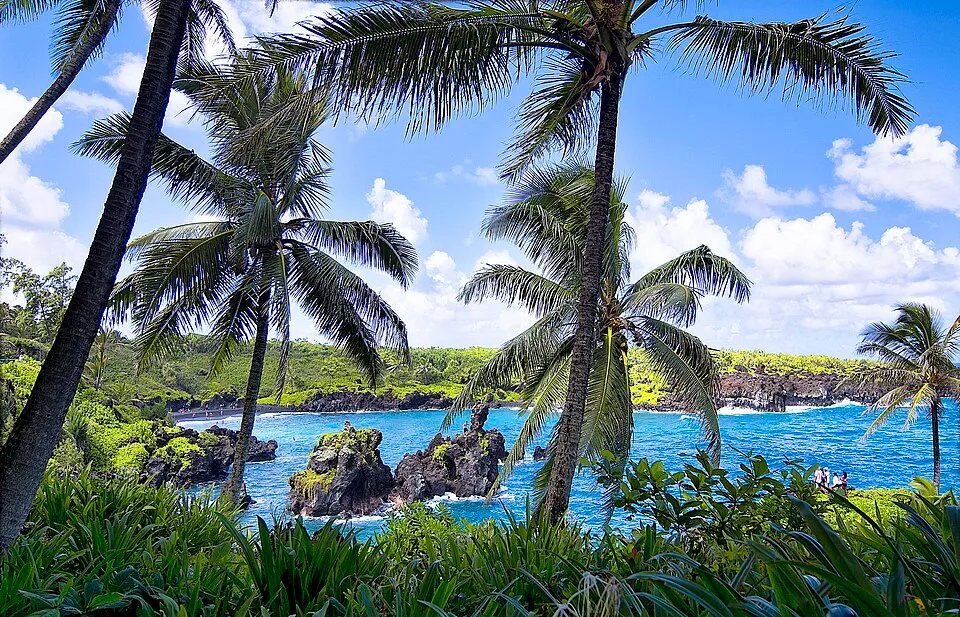
Waianapanapa State Park stands as a testament to the natural artistry and rich history of Maui. Its famed black sand beach is more than just a striking visual spectacle—it is a narrative of volcanic wonder, cultural reverence, and the timeless beauty of Hawaii’s landscapes. Whether you’re drawn by the allure of its geology, the depth of its historical roots, or the call of its serene natural environment, a visit to Waianapanapa offers a truly transformative experience.
Embark on your journey to this captivating corner of Hana, and discover the stories that have shaped one of Maui’s most cherished natural treasures. If you would like to set a reservation for Waianapanapa State Park, this is the only website you are able to set a date and time for your adventure: https://gostateparks.hawaii.gov/waianapanapa
Maui’s famous black sand beach is located at Waiʻānapanapa State Park near Hāna on the island’s eastern coastline. The park is a popular stop along the Road to Hāna and is known for its small black sand beach, volcanic coastline, sea stacks, native hala forest, hiking trails, and other natural features.
The best-known black sand beach on Maui is commonly called Waiʻānapanapa Black Sand Beach and is located within Waiʻānapanapa State Park. The beach itself is also known as Paʻiloa Beach.
The black shoreline at Waiʻānapanapa is the result of Maui’s volcanic geology. Volcanic material has been broken down over time by waves and natural erosion, creating the distinctive dark shoreline that contrasts dramatically with the blue Pacific Ocean and surrounding green vegetation.
Yes. Waiʻānapanapa is one of the most distinctive stops along the Road to Hāna. Beyond its famous black sand beach, visitors can experience a rugged volcanic coastline, sea stacks, native vegetation, coastal hiking, a natural stone arch, blowholes, and impressive ocean views.
Yes, if you are a non-Hawaiʻi resident. Advance reservations are currently required for nonresident visitors entering Waiʻānapanapa State Park. Both entry and parking should be reserved before arriving if you are driving into the park. Hawaiʻi residents with valid state identification do not require the same visitor reservation.
Nonresident visitors should not arrive without a reservation. Waiʻānapanapa State Park does not offer same-day reservations at the entrance, and visitors without the required advance reservation may be turned away.
Waiʻānapanapa parking and entry reservations are currently released up to 30 days in advance. Because popular time slots can sell out, visitors planning their Road to Hāna itinerary should consider making their reservation as soon as their desired date becomes available.
Current nonresident fees are $5 per person for entry and $10 per non-commercial vehicle for parking. Children age three and younger are admitted free. Hawaiʻi residents with a valid Hawaiʻi driver's license or state ID receive free entry and parking. Always check the official State Parks website for current fees before your visit.
Waiʻānapanapa State Park is currently open daily from 7:00 a.m. to 6:00 p.m. Reservation times and park access are controlled, so visitors should arrive during their assigned reservation period.
Visitors may enter the water when conditions allow, but Waiʻānapanapa has a rugged, exposed coastline where ocean conditions can change. Waves, currents, and surf can make swimming hazardous. Always evaluate current conditions and follow posted warnings before entering the ocean.
Families can enjoy Waiʻānapanapa, especially for sightseeing, photography, picnicking, and exploring the park. However, parents should closely supervise children around the ocean, cliffs, rocks, blowholes, trails, and other natural features.
Many visitors spend approximately one to two hours exploring Waiʻānapanapa, although travelers interested in hiking, photography, picnicking, or exploring more of the coastline may want additional time. Your reservation window should also be considered when planning the rest of your Road to Hāna itinerary.
Yes. Waiʻānapanapa State Park is located near Hāna and is one of the most popular stops associated with the Road to Hāna. Because reservations are required for nonresidents, it is one of the Road to Hāna stops that should be planned in advance rather than visited spontaneously.
Waiʻānapanapa State Park is located only a few miles from Hāna town. Its location makes it easy to incorporate into a day exploring Hāna and the surrounding East Maui coastline.
Yes. Waiʻānapanapa is very close to Hāna and is commonly included as part of a Road to Hāna itinerary. Visitors should build their day around their Waiʻānapanapa reservation time and allow plenty of time for the winding Hāna Highway.
Wear comfortable clothing and sturdy footwear suitable for rocks, trails, and uneven terrain. Bring sun protection, drinking water, and rain protection because East Maui weather can change quickly. Water shoes can also be useful if you plan to approach the shoreline.
Visitors should leave sand, rocks, plants, and other natural materials where they find them. Removing natural resources can damage the environment and diminish these special places for future visitors. A photograph makes a much better souvenir.
Yes. Waiʻānapanapa offers coastal hiking opportunities, including portions of the historic Ke Ala Loa O Maui/Piʻilani Trail. The landscape provides a chance to see Maui’s rugged volcanic coastline beyond the famous black sand beach.
Yes, camping is available by permit and advance reservation. Waiʻānapanapa also has cabins, making it possible to experience this part of East Maui beyond a short Road to Hāna stop. Camping and cabin reservations are separate from ordinary day-use entry.
Maui has other areas with dark volcanic sand and rocky volcanic coastline, particularly around East and South Maui. However, Waiʻānapanapa is the island’s most famous and easily recognized black sand beach and is the one most visitors mean when searching for “Maui black sand beach.”
Waiʻānapanapa offers much more than its famous shoreline. The park includes a wild volcanic coastline, native hala forest, sea stacks, blowholes, a natural stone arch, hiking opportunities, cultural sites, and scenic ocean views.
Waiʻānapanapa is commonly translated in reference to “glistening” or “sparkling waters.” The name reflects the area's strong connection to water and the striking natural landscape surrounding the park.
Because Waiʻānapanapa is located near Hāna, visitors can combine it with other East Maui experiences such as exploring Hāna town, scenic viewpoints, waterfalls, tropical landscapes, coastal areas, and other stops along the Road to Hāna.
If you would like to read and learn more about interesting things in Hawaii! Check out our blog page here on our website!
or
Image Credits:
Hero:
"Forest in bay on sea shore" by Kelsey, via Pexels
Photo: Dana Hutchinson, via Wikimedia Commons. Licensed under Creative Commons Attribution 3.0 (CC BY 3.0).
Ziplines have evolved from a simple mode of transportation to a thrilling outdoor adventure activity, but their origins date back centuries. Today, ziplines are a very popular attraction at theme parks, nature reserves, and adventure destinations, offering an exhilarating way to soar through the air. However, the history of ziplines is far more complex, with roots in both practical and cultural applications across different parts of the world.
The earliest known use of ziplines can be traced back to ancient civilizations. While the term “zipline” itself is relatively modern, the basic concept of using a suspended cable to travel from one point to another has been around for centuries.
In China, the idea of harnessing a cable for transportation is documented as early as the 6th century AD. During the Tang Dynasty, ziplines were used in military operations. Soldiers would use ropes and cables to cross valleys or gorges, helping them avoid long and dangerous detours. In fact, similar cable systems, known as "flying bridges," were an integral part of military strategy in China and other parts of Asia. These bridges were often used to span difficult terrain such as rivers, cliffs, or ravines, allowing troops to travel quickly and safely.
Meanwhile, in South America, indigenous peoples in the Andes Mountains used a form of zipline-like technology for practical purposes, such as crossing ravines or moving goods between villages. While these systems were less mechanized than modern ziplines, they were similarly designed to help people navigate difficult and often inaccessible geography.
As technology and engineering advanced, the practical applications of ziplines began to evolve. By the early 20th century, the concept of the aerial cableway gained popularity, particularly for industrial purposes. These cable systems were primarily used to transport materials like mining ores, timber, or other heavy goods across rough terrain. The use of zipline technology in this context was key in industries that operated in mountainous or forested regions, where traditional methods of transport were either too slow or impossible.
It wasn’t until the 1950s that ziplines began to appear outside of industrial settings in the form that we recognize today: a leisure activity. In Costa Rica, naturalists and biologists, particularly in remote rainforests, started using ziplines to traverse dense forest canopies. This allowed them to conduct research and study the flora and fauna of these areas without disturbing the delicate ecosystem on the ground.
In the 1970s and 1980s, the potential for ziplines as an adventure tourism attraction started to gain momentum. The first commercial zipline attraction is believed to have been established in Costa Rica in 1979. This attraction, designed for tourists eager to experience the rainforest from a unique perspective, introduced the world to the thrill of gliding between treetops.
The idea quickly spread to other adventure destinations around the world. By the late 1990s, companies began to build large zipline complexes in countries like the United States, New Zealand, and Australia. These ziplines were often part of broader adventure parks, offering tourists the chance to fly across ravines, forests, and mountains, sometimes at speeds over 50 miles per hour.
The experience became more refined with the introduction of dual cable systems, harnesses, and braking mechanisms, which improved both safety and comfort for riders. In the 2000s and 2010s, companies began to build even larger, more elaborate zipline courses, including multi-tower systems and super-long ziplines that span hundreds or even thousands of feet in length. The thrill of riding through vast canyons, mountain ranges, or dense forests became a key selling point for eco-tourism and adventure tourism operators.

Today, ziplining has become a staple of eco-tourism and adventure travel. Zipline operators are constantly pushing the envelope, creating new and exciting experiences for thrill-seekers. Some of the most impressive ziplines in the world can be found in destinations like:
The popularity of ziplining has also expanded beyond its traditional locations. For example, some cities are introducing urban zipline experiences that allow adventurers to fly over iconic landmarks, sports stadiums, or downtown districts.
In addition to thrilling recreation, ziplines have also found use in conservation efforts, with some operators building zipline courses to help protect and preserve natural areas. For instance, some zipline tours are carefully designed to minimize the environmental impact of tourism and provide funding for local conservation projects.

As technology continues to improve, the future of ziplines looks promising. From solar-powered ziplines to innovations in safety protocols, new trends in zipline design are emerging to enhance the experience for participants while reducing the environmental impact. Additionally, modern ziplines are becoming more inclusive, with operators designing courses and equipment that cater to a wider range of physical abilities.
Zipline technology may also continue to influence other fields. For instance, some companies are exploring the use of aerial cableways in urban transport systems to alleviate congestion and reduce the carbon footprint of public transit. These systems, while still in the experimental phase, could offer a new form of travel, making the technology behind ziplines even more pervasive in our daily lives.
From ancient military tools to a beloved recreational activity, the history of ziplines is a testament to human ingenuity and adaptability. What began as a practical method for crossing rough terrain has transformed into an exhilarating form of entertainment enjoyed by millions worldwide. Whether you're zooming through a tropical rainforest or soaring above a mountain range, ziplines offer a unique perspective on the world, and their future holds endless possibilities for both adventure and innovation.

There is no single inventor of the zipline. Ropeways and cable-based transportation systems have been used in mountainous regions for centuries. The modern recreational zipline developed much later, influenced by climbing techniques, rainforest canopy research, and the emergence of commercial canopy tours.
The basic idea behind a zipline is centuries old. People living in mountainous regions developed rope and cable crossings as practical ways to move people and supplies across difficult terrain. Modern recreational ziplining emerged much more recently, particularly during the late 20th century.
Long before ziplines became tourist attractions, similar rope and cable systems were used for transportation. They provided a practical way to cross rivers, ravines, valleys, and other terrain where constructing a traditional road or bridge was difficult.
There is no single confirmed birthplace of the earliest zipline-like systems. Forms of ropeways and aerial crossings have historically been associated with mountainous regions in different parts of the world. The modern commercial canopy-tour experience, however, is strongly associated with Costa Rica.
Historical accounts of zipline development often point to ropeways and aerial transportation systems used in mountainous regions of China and elsewhere in Asia. These systems were created primarily for transportation rather than recreation and represent early examples of the basic concept behind modern ziplines.
Early aerial crossings were much simpler than today's recreational ziplines. They relied on ropes, cables, pulleys, baskets, or other basic systems to move people and goods across difficult terrain. Modern ziplines use specialized harnesses, carabiners, trolleys, engineered cables, braking systems, and other safety equipment.
Rainforest researchers played an important role in the development of modern canopy exploration. During the 1970s and 1980s, researchers developed techniques for accessing and moving through forest canopies so they could study ecosystems that were difficult to observe from the ground.
Rainforest canopies contain enormous amounts of plant and animal life, but studying them from the forest floor is difficult. Rope systems, climbing techniques, platforms, and aerial traverses allowed researchers to spend more time high in the trees and move through areas that had previously been difficult to access.
Donald Perry was a biologist and canopy researcher whose work helped pioneer methods for studying tropical rainforest canopies. His research in Costa Rica during the 1970s and 1980s contributed to techniques for moving through and observing the forest canopy that influenced the later development of recreational canopy experiences.
Costa Rica played a major role in transforming canopy exploration into a recreational activity. Its tropical forests provided an ideal environment for canopy research and, eventually, commercial tours that allowed ordinary visitors to experience the forest from above.
Commercial canopy tours began developing during the late 20th century. The Original Canopy Tour in Monteverde, Costa Rica, traces its public operation to 1994 and describes itself as the world's first commercial canopy tour.
A canopy tour is an outdoor experience designed to move participants through or above a forest canopy. Modern canopy tours often combine multiple ziplines with elevated platforms and may also incorporate suspension bridges, rappelling, climbing elements, or other aerial features.
Not exactly. A zipline is an individual cable or system that allows a participant to travel between two points. A canopy tour typically consists of multiple ziplines and platforms arranged as a larger guided experience through a forest or other natural environment.
Traditional ziplines use gravity to move a rider from a higher point toward a lower point. The slope of the cable, along with factors such as rider weight, cable length, tension, weather, and braking systems, influences how a rider travels along the line.
A modern recreational zipline typically uses a steel cable stretched between two anchor points. The participant wears a harness connected to a trolley that travels along the cable. Gravity provides the movement, while the course's design and braking system help control the rider's arrival.
Commercial ziplines generally use engineered steel cable rather than the ropes associated with much older aerial crossings. The complete system also includes engineered anchors, hardware, trolleys, harnesses, connectors, and braking equipment appropriate for the course's design.
As canopy tours gained popularity in destinations such as Costa Rica, the concept spread internationally. Operators began adapting ziplines to forests, mountains, valleys, resorts, adventure parks, and other landscapes, helping turn a once-practical form of transportation into a major outdoor recreation activity.
Ziplining combines outdoor scenery with speed, height, and adventure while allowing participants to experience a landscape from an unusual perspective. Courses can also be designed for different levels of intensity, helping make the activity appealing to a broad range of travelers.
The technology behind ziplining has changed dramatically. Early rope crossings were designed primarily as practical transportation systems and lacked the specialized recreational equipment used today. Modern commercial courses incorporate engineered cables and anchors, purpose-built harnesses and trolleys, braking systems, inspections, and established operating procedures.
Although ziplining is now strongly associated with recreation, aerial ropeways and cable systems have continued to serve practical purposes in remote and mountainous regions. Modern bridges, roads, and other infrastructure have replaced many older crossings.
As adventure tourism expanded internationally, zipline courses were developed in Hawaiʻi to take advantage of the islands' mountains, valleys, forests, and dramatic scenery. Today, ziplining is one of the many outdoor activities available to visitors looking to experience Hawaiʻi beyond its beaches.
Modern Maui zipline tours combine the basic gravity-powered concept of historic ziplines with contemporary equipment and professionally designed courses. Depending on the location, riders can experience forests, valleys, mountains, historic landscapes, and views that provide an entirely different perspective of Maui.
Yes. While the earliest ziplines did not originate on Maui, visitors can experience the modern evolution of the activity at Maui zipline courses. NorthShore Zipline in Haʻikū combines an aerial adventure with the historic grounds of Camp Maui, a former World War II-era U.S. Marine training base.
If you would like to read and learn more about interesting things in Hawaii! Check out our blog page here on our website!
or
The legendary northshore break called Pe’ahi, or known for its more notorious name Jaws, is Maui’s most iconic and powerful surf break, renowned for its incredibly massive waves and exhilarating conditions. Consistently recognized at the prestigious Big Wave Awards, Jaws has earned the title of the most winning break more times than any other location. Jaws or Pe’ahi can be located in the beginning of the iconic Road to Hana. During the winter time and when the waves are firing, elite surfers from all around the globe are just given a few days notice to head out and converge on this legendary spot, while spectators gather in awe to witness the spectacle of natures raw power.
While the name “Jaws” is the most widely recognized name for this iconic surf break, locals knew it as the name “Pe’ahi” which has gained popularity in recent years, particularly with surfers seeking to honor and connect with the local Hawaiian Culture. “Pe’ahi” refers to the much larger ahupua’a (land division) in the area. Hawaiian Kupuna Leslie Kuloloio shares that the traditional Hawaiian name for this spot is “Ke Kai ‘o Waitakulu”, which translates into “The Teary Eye”. This particular name reflects on the deep cultural significance of the location, offering a richer perspective on the surf breaks history and meaning.
Around the early 1990s, surfers would then make some of their first attempts to ride Jaws during Maui’s winter swells. Winter is around the time where the pacific will deliver its most intense waves and powerful swells. During this time it was nearly impossible to ride or paddling into these waves as the widely known “tow-in surfing” method wasnt utilized yet; however, the popularization of this “tow-in technique”, allowed surfers the chance to face waves of this magnitude which was never before seen. David Kalama, Laird Hamilton, and Darick Doener would become pioneering figures in this evolution into big wave surfing, and were known for famously riding some of the first monster waves at Jaws. This would then help to solidify the legendary status and world-wide appeal of big-wave surfing.
By the late 1990s and early 2000s, Peʻahi (Jaws) had firmly cemented its status as the epicenter of big-wave surfing. Known for its towering heights, remarkable speed, and glassy barrels, Jaws presented a new level of challenge for surfers. Its steep, barreling waves broke with such precision and power that it quickly distinguished itself from other famous big-wave spots like Waimea Bay on Oahu or Mavericks in California. Unlike these other locations, where waves can be more unpredictable, Jaws' consistent, powerful breaks pushed the limits of what was possible in the sport, drawing surfers eager to test their skill and bravery on one of the most extreme waves on Earth.
Historically, one of the key factors that enabled surfers to tackle Jaws' massive waves was the introduction of tow-in surfing. This technique involves surfers being towed into the wave by a Jet Ski, allowing them to reach the necessary speed and angle to catch waves that would otherwise be impossible to paddle into. In the early days of big-wave surfing at Jaws, tow-in was essential for safely navigating the giant swells. Without this method, many of the waves at Peʻahi would have been out of reach for even the most experienced surfers.
However, in recent years, the evolution of surfboard technology and techniques has led to a shift in how surfers approach Jaws. A new generation of athletes is now attempting to paddle into these colossal waves on their own, eschewing the tow-in method in favor of relying on their raw skill and strength. This shift is a testament to the growing capabilities of modern surfboards, which are designed to handle the massive forces of waves like those at Jaws. Lighter, more maneuverable boards, along with improved wetsuits and safety gear, have enabled surfers to take on this once tow-in-exclusive break using traditional paddle techniques.
This shift not only speaks to the rapid advancements in surf technology but also reflects a broader evolution in the culture of big-wave surfing. As surfers push the boundaries of what’s possible at Peʻahi, Jaws remains a proving ground where both technology and technique continue to evolve, and where the spirit of adventure and challenge is always front and center. The continued progress at Jaws serves as a reminder that big-wave surfing, much like the waves themselves, is constantly in motion—always changing, always challenging, and always inspiring those who are brave enough to take it on.
In 2016, the World Surf League introduced the Peʻahi Challenge, a major big-wave competition that cemented Jaws as the ultimate proving ground for surfers. The event brought together the world’s top surfers to face Peʻahi’s massive waves in a competitive setting, showcasing the raw power and precision required to ride one of the most challenging surf breaks on Earth. Not only did the competition elevate Jaws’ iconic status, but it also highlighted the exceptional skill and bravery needed to conquer its towering barrels.
Despite its allure, Jaws remains an extremely dangerous wave, known for its colossal wipeouts and broken boards. Surfers must exercise precision and mental fortitude to navigate its powerful swells, making it a high-risk endeavor even for seasoned professionals. Over the years, advancements in safety gear—such as enhanced vests, helmets, and the use of tow-in jet skis—have made it possible for surfers to take on these massive waves with more protection. Still, Jaws continues to push the limits of big-wave surfing, testing both the physical and psychological resilience of those who dare to ride its waters.
Peʻahi (Jaws) is not only a world-renowned surf destination, but it also holds profound cultural and environmental significance. Located on Maui’s rugged north shore, Jaws is deeply intertwined with Hawaiian traditions, where the ocean, or Kai, is revered. For many surfers, riding the waves at Jaws is a spiritual connection to the sea—honoring both its immense power and the respect it commands within Hawaiian culture.
However, as Jaws attracts more attention from surfers and tourists, environmental concerns have risen. The popularity of the spot brings with it the need for sustainable practices to protect the coastal ecosystems. Preserving the marine life and natural beauty of the area is crucial, as increased traffic threatens to disrupt the delicate balance of this pristine environment.
The history of Jaws is also integral to the evolution of big-wave surfing. Once a near-mythical break, it has become an iconic symbol in extreme sports. Technological advancements, such as tow-in surfing, jet skis, and improved safety gear, have made it possible to ride waves of unprecedented size and power. Yet, Jaws remains a place that challenges even the most experienced surfers, testing both their physical and mental limits.
As a natural wonder and a test of human endurance, Jaws continues to inspire surfers from around the globe. Its awe-inspiring waves not only push the boundaries of big-wave surfing but also serve as a reminder of the importance of respecting and protecting the ocean that makes such feats possible. Whether admired from the shore or conquered by the bravest athletes, Jaws stands as a testament to the spirit of adventure and the enduring bond between surfers and the sea.
Jaws is the nickname commonly used for Peʻahi, Maui’s legendary big-wave surf break on the island’s North Shore. During powerful winter swells, Peʻahi can produce enormous, fast-moving waves that attract some of the world’s most accomplished big-wave surfers.
Jaws is located at Peʻahi along Maui’s rugged North Shore, east of Hoʻokipa and near Haʻikū. The surf break lies offshore below coastal bluffs and is associated with the beginning portion of the Hāna Highway region.
The nickname “Jaws” became associated with the surf break because of how dramatically conditions can change when a major swell arrives. What may appear relatively quiet can transform into an extremely powerful big-wave environment.
Jaws refers to the famous big-wave surf break at Peʻahi. Peʻahi is the Hawaiian place name associated with the surrounding area, while “Jaws” became the internationally recognized nickname for the surf break.
During major North Pacific swells, Jaws can produce exceptionally large waves with faces reaching several stories high. Wave size varies considerably depending on swell height, period, direction, wind, and other ocean conditions.
Peʻahi is a deep-water reef break that responds to powerful North Pacific swells. When large, long-period swell energy reaches the underwater reef, the changing water depth forces that energy upward, creating the enormous waves that have made Jaws famous.
Winter is the primary big-wave season at Jaws. Powerful North Pacific storms can send large north and northwest swells toward Maui, particularly from roughly November through March. However, Jaws does not produce enormous waves every day during winter.
No. Jaws requires a significant swell with the right direction and other favorable conditions. On many days, Peʻahi looks completely different from the massive waves shown in famous photographs and surfing videos.
Surfers and spectators monitor surf forecasts, swell height, swell period, swell direction, wind, and offshore buoy information. Major Jaws events can sometimes be anticipated several days ahead as powerful North Pacific storms develop.
No. Jaws is an extreme big-wave surf break appropriate only for highly experienced big-wave surfers with specialized training, equipment, and safety support. Even professional surfers treat Peʻahi with tremendous caution because of its wave size, speed, reef, and powerful currents.
Peʻahi has been associated with many influential big-wave surfers. Early tow-in pioneers such as Laird Hamilton, Darrick Doerner, Buzzy Kerbox, and Dave Kalama helped establish the break’s reputation, while later generations of elite surfers continued pushing the limits of what could be ridden there.
Tow-in surfing uses a personal watercraft to pull a surfer into a large wave at higher speed than the surfer could typically achieve by paddling. The technique became closely associated with Jaws because it allowed surfers to catch waves once considered too large or fast to enter using traditional paddling methods.
Jaws played an enormously important role in the development and popularization of modern tow-in surfing. During the 1990s, a group of Maui watermen experimented with personal watercraft, foot straps, specialized boards, and other techniques that allowed them to tackle increasingly large waves at Peʻahi.
Yes, tow-in surfing remains part of big-wave surfing at Peʻahi, particularly under extreme conditions. However, advances in surfboards, training, safety equipment, and big-wave technique have also allowed elite surfers to paddle into waves at Jaws that were once considered impossible to catch without assistance.
Jaws helped redefine what surfers believed was possible on extremely large waves. The experimentation that occurred at Peʻahi contributed to advances in tow-in surfing, surfboard design, water safety, rescue techniques, and eventually modern paddle-in big-wave surfing.
Peʻahi is famous for combining enormous size with remarkable speed and wave shape. Its ability to produce huge, powerful waves with rideable faces and barrels has helped establish it as one of the most recognizable big-wave surfing locations in the world.
Jaws is widely regarded as one of the world’s premier big-wave surf breaks. Other famous giant-wave locations include Nazaré in Portugal, Mavericks in California, and Waimea Bay on Oʻahu, but Peʻahi remains particularly famous for the combination of size, speed, shape, and surfability of its waves.
When Jaws is breaking, spectators sometimes watch the action from the elevated bluffs around Peʻahi. However, the surrounding terrain is rugged and undeveloped, and access conditions can be difficult. Visitors should respect private property, posted restrictions, road conditions, and cliff hazards.
Watching from land can still involve hazards. The Peʻahi coastline includes steep cliffs, rough terrain, exposure to sun and wind, and potentially difficult road conditions. Spectators should stay well away from cliff edges and obey all signs, barriers, and access restrictions.
Jaws should not be treated as a recreational swimming area, especially when a significant swell is present. The break is known for extremely powerful waves and currents. Visitors looking to swim should choose an appropriate beach and check current ocean conditions.
Big-wave surfers at Peʻahi can reach very high speeds because of the steep faces and tremendous energy of the waves. Exact speeds vary depending on wave size, the surfer’s line, equipment, and conditions.
Big-wave surfers use specialized equipment designed for speed, stability, and control. Paddle-in surfers may use long big-wave boards commonly called “guns,” while tow-in surfing has historically used smaller specialized boards equipped with foot straps.
Big-wave surfers may use specialized inflatable safety vests to help them return toward the surface following a severe wipeout. These systems are only one component of a much larger safety approach that can include helmets, personal watercraft, rescue teams, extensive training, and communication between surfers.
Peʻahi is located along Maui’s North Shore near the early portion of the Hāna Highway corridor. However, Jaws is not a developed Road to Hāna attraction with a conventional parking lot, visitor center, or easily accessible roadside viewpoint.
If a major swell arrives during your trip, seeing Jaws can be an extraordinary experience. Peʻahi showcases the raw power of Maui’s winter surf and the abilities of elite big-wave surfers. However, because the wave requires specific conditions, visitors should never assume Jaws will be breaking simply because they are visiting during winter.
Maui’s North Shore contains several internationally known surf locations. Hoʻokipa Beach is famous for surfing and windsurfing, while farther west, Honolua Bay can produce excellent surf during winter swells. Together, these locations have helped establish Maui as an important destination in global surfing culture.
Visitors exploring Maui’s North Shore can experience Pāʻia, Hoʻokipa, Haʻikū, local restaurants, beaches, scenic drives, waterfalls, and outdoor adventures. The area is also home to NorthShore Zipline in Haʻikū, making it easy to combine North Shore sightseeing with another Maui adventure.
If you would like to read and learn more about interesting things in Hawaii! Check out our blog page here on our website!
or
Image Credits:
Hero:
Photo: Margaret Hallahan, via Wikimedia Commons. Licensed under Creative Commons Attribution-ShareAlike 4.0 International (CC BY-SA 4.0).